
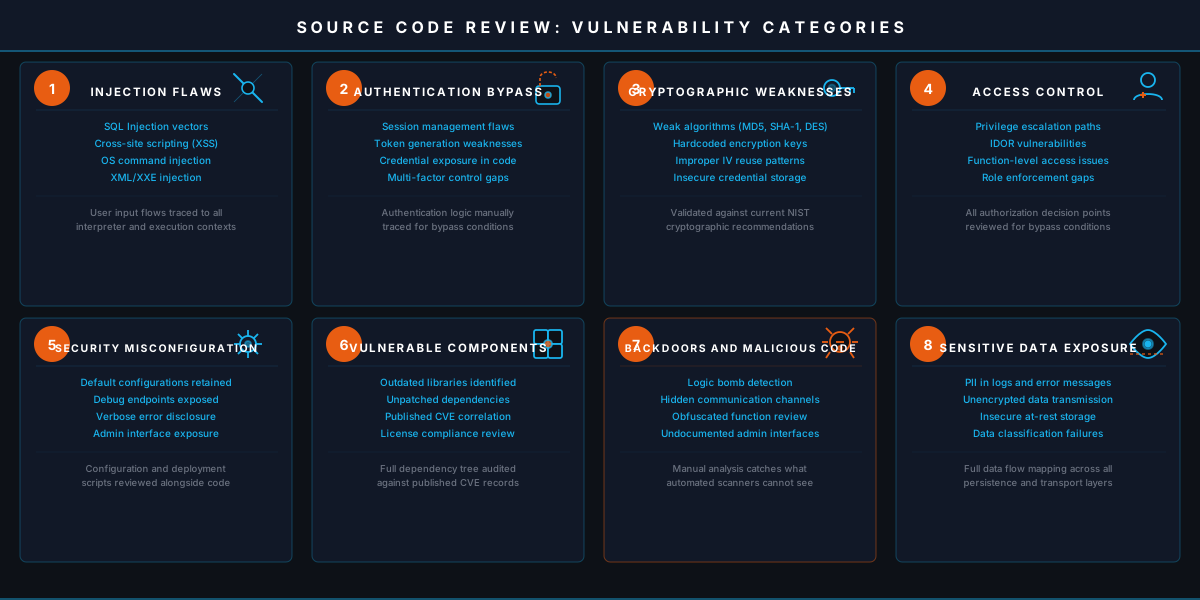
What a Source Code Security Review Covers
Automated vulnerability scanners operate at the surface level. They flag known patterns and previously catalogued signatures, but they cannot reason about application logic, trace data flows through custom business rules, or recognize a deliberately concealed backdoor that deviates from no published signature. NYCF's source code security review is a manual, analyst-driven process that examines the code itself, not just its compiled behavior. Source code findings are often validated through penetration testing against the running application. Organizations seeking a broader view of their attack surface can combine code review with a vulnerability assessment covering network and infrastructure layers.
Our analysts conduct Static Application Security Testing (SAST) across the full codebase, tracing execution paths, identifying logic flaws, and mapping every point where user-supplied input interacts with system resources. We examine authentication and session management code for bypass conditions, weak token generation, and privilege escalation paths that standard tooling would classify as acceptable. Cryptographic implementations are reviewed against current NIST recommendations, with particular attention to deprecated algorithms (MD5, SHA-1, DES), weak key sizes, improper IV reuse, and hardcoded encryption keys.
Third-party libraries and open-source dependencies receive their own audit pass. Software supply chain attacks have demonstrated repeatedly that a trusted internal codebase can be undermined by a single compromised or outdated dependency. NYCF verifies version integrity, checks published CVE records for each included library, and reviews license compliance for organizations where open-source license obligations carry legal exposure.
NYCF's Code Review Methodology
Every source code security review at NYCF begins with scoping: we establish which components, languages, and modules are in scope, document the application's architecture and trust boundaries, and define what a finding must contain to be actionable for the legal or technical teams receiving the report. This upfront scoping prevents the unfocused reviews that produce exhaustive lists of low-severity findings while missing the critical logic flaws that actually matter.
Our analysts work against the OWASP Top 10 and the CWE/SANS Top 25 Most Dangerous Software Weaknesses as baseline taxonomies, ensuring that our coverage aligns with the vulnerability frameworks courts and regulators recognize. For government and federal contractor engagements, we align findings to NIST SP 800-64, the guide to security considerations in the system development life cycle. Tooling includes SonarQube, Checkmarx, and Semgrep for automated pattern identification, but every tool-flagged finding is manually verified by a certified analyst before it enters the report. False positives are excluded entirely.
Deliverables are structured specifically for litigation and attorney review. The findings report assigns a severity rating (Critical, High, Medium, Low, Informational) to every issue using CVSS v3.1 scoring, accompanied by a plain-language description of the vulnerability, its potential for exploitation, and specific remediation recommendations. For matters involving active litigation, NYCF preserves full chain-of-custody documentation for the code repository snapshot, including cryptographic hash verification, evidence intake records, and examiner notes, so that our analysis can withstand challenge in discovery or at trial.
Scoping and Evidence Intake
We establish scope, obtain a forensically preserved copy of the codebase with hash verification, and document chain-of-custody from intake through report delivery.
Automated SAST Pass
SonarQube, Checkmarx, and Semgrep run against the full codebase to flag known vulnerability patterns, insecure function calls, and dependency issues at scale.
Manual Expert Review
Certified analysts conduct line-by-line review of critical modules, verifying every tool finding and examining logic, data flows, and authentication paths that tools cannot assess.
Findings Verification and Severity Ranking
Every candidate finding is verified manually. False positives are removed. Confirmed vulnerabilities receive CVSS v3.1 scores and are ranked by exploitability and impact.
Attorney-Ready Report Delivery
The final report includes an executive summary for legal teams, technical detail for developers, remediation recommendations, and litigation-ready chain-of-custody documentation.
Who Needs a Source Code Security Review
Source code security review serves a wide range of legal, regulatory, and operational purposes. For law firms handling intellectual property theft matters, NYCF's forensic examination of source code can establish whether proprietary algorithms, trade secrets, or proprietary data structures were copied, embedded, or modified in a defendant's codebase. This type of technical analysis supports infringement claims, trade secret misappropriation cases under the Defend Trade Secrets Act, and employment disputes involving departed engineers.
Organizations conducting software acquisitions or technology due diligence rely on source code review to identify hidden technical debt, undisclosed security vulnerabilities, and licensing entanglements before the transaction closes. A codebase that appears functional may contain critical SQL injection vulnerabilities, obsolete cryptographic implementations, or dependency chains that introduce significant post-acquisition liability. NYCF provides acquisition-focused reviews with clear findings tied to deal risk.
Regulatory compliance requirements for source code security span multiple frameworks. PCI DSS Requirement 6 mandates secure software development practices and requires application vulnerability assessments for in-scope payment applications. HIPAA's Security Rule requires covered entities and business associates to assess technical safeguards in software handling protected health information. FedRAMP authorization for cloud service providers requires thorough code-level security documentation. Criminal defense matters involving allegations of unauthorized computer access under 18 U.S.C. 1030 may require forensic examination of the code in question to establish whether access was technically authorized, whether exploited vulnerabilities were publicly known, or whether a defendant's actions caused the damages alleged.
IP Theft Litigation
Forensic code comparison to prove trade secrets were copied, embedded, or misappropriated. NYCF's analysis supports expert witness testimony in state and federal courts.
Acquisition Due Diligence
Pre-acquisition code review identifies hidden vulnerabilities, licensing exposure, and technical liabilities before they become post-closing obligations.
Regulatory Compliance
PCI DSS Requirement 6, HIPAA technical safeguards review, and FedRAMP code-level security documentation for regulated industries and government contractors.
Breach Post-Mortems and Criminal Defense
Forensic code analysis following a breach to identify the exploited flaw, and expert technical review in criminal matters involving alleged unauthorized computer access.
Application Security Testing
Source code review is the most thorough method for identifying security vulnerabilities in application software, but it is not always sufficient on its own. The way an application behaves at runtime, the security of the APIs it exposes, and the vulnerabilities introduced by its dependencies can only be fully evaluated through a combination of testing methodologies. NYCF's application security testing practice integrates Static Application Security Testing (SAST), Dynamic Application Security Testing (DAST), Interactive Application Security Testing (IAST), and Software Composition Analysis (SCA) with manual expert review to provide the most complete security picture available for a given application.
SAST examines source code, bytecode, or compiled binaries without executing the application. Automated SAST tools parse the codebase and apply rule sets derived from known vulnerability patterns to identify potentially dangerous code constructs, insecure function calls, and data flows where user-controlled input reaches sensitive operations without adequate validation. NYCF uses industry-standard SAST tooling including SonarQube, Semgrep, and Checkmarx, but the critical differentiator is analyst involvement: every tool-flagged finding is manually reviewed by a certified security analyst before entering the report. Automated SAST tools produce substantial false positive rates that make raw tool output unsuitable for direct use in litigation or compliance reporting. Manual verification eliminates false positives and adds the contextual analysis needed to assess actual exploitability.
DAST tests the deployed application from the outside, sending crafted HTTP requests and other inputs to identify vulnerabilities that manifest only at runtime. DAST finds issues that SAST cannot: server configuration weaknesses, runtime access control failures, session management vulnerabilities that depend on application state, and injection flaws that are triggered only by specific input sequences that static analysis cannot fully anticipate. NYCF conducts authenticated DAST testing against staging or production-equivalent environments, covering the OWASP Top 10 and extended vulnerability categories relevant to the specific application type. DAST results are combined with SAST findings to produce a unified view of the application's security posture that accounts for both code-level and runtime vulnerabilities.
IAST instruments the application itself during testing, placing agents inside the running application to monitor execution in real time as it processes test inputs. This approach identifies vulnerabilities with lower false positive rates than either SAST or DAST alone, because the agent can observe the actual data flow through the application in response to test inputs rather than inferring it from static code analysis or external response observation. IAST is particularly effective for complex enterprise applications where the data flow between components is difficult to trace through static analysis, and for applications using frameworks or languages that present challenges for conventional SAST tools.
Software Composition Analysis addresses the open-source and third-party dependencies that make up a substantial portion of most modern applications. SCA tools scan the application's dependency manifest and installed packages against CVE databases and security advisories to identify known vulnerable versions. Beyond vulnerability identification, SCA produces a Software Bill of Materials (SBOM) that documents every dependency and its version, a deliverable increasingly required by government contracts, enterprise procurement requirements, and emerging software supply chain regulations. NYCF's SCA work also covers license compliance: open-source licenses impose conditions on code that incorporates or links to licensed components, and violations can create legal exposure that is material in acquisition due diligence and in litigation involving software copyright.
API security testing has become essential as organizations shift toward microservice architectures where business logic is distributed across dozens or hundreds of API endpoints. APIs that are not documented, that have inconsistent authentication enforcement, or that expose administrative functions to non-privileged callers represent significant attack surface that neither traditional web application testing nor source code review alone will fully cover. NYCF tests APIs against the OWASP API Security Top 10, examines GraphQL and REST endpoints for authorization failures, tests rate limiting and resource consumption controls, and reviews API gateway configuration for authentication bypass conditions and excessive exposure of internal services.
Mobile application security testing covers both the iOS and Android clients that front-end many enterprise applications, as well as the APIs those clients consume. Mobile apps present distinct security considerations: local data storage in cleartext, certificate pinning bypass vulnerabilities, insecure inter-process communication through Intents and URL schemes, hardcoded credentials or API keys embedded in the compiled binary, and runtime tampering through dynamic instrumentation. NYCF performs static analysis of mobile application binaries using reverse engineering tools alongside dynamic testing of the running application and its network communications.
DevSecOps integration supports organizations that want to embed security testing into their software development lifecycle rather than treating it as a post-development gate. NYCF designs security testing pipelines that run SAST on every pull request, SCA on every dependency update, and DAST against every deployment to a staging environment, with severity thresholds that block deployments when critical findings are identified. Security requirements defined during the design phase, tested during development, and validated at deployment are more cost-effective and more reliable than security testing performed only before release. Organizations with frequent release cycles and regulated software products benefit particularly from this integrated approach, as it produces the continuous testing evidence that PCI DSS, FedRAMP, and similar frameworks expect.