The IoT Security Problem
IoT devices are uniquely difficult to secure for reasons that are structural, not incidental. Most consumer and industrial IoT devices are built to price and power constraints that leave little room for security features. Hardcoded credentials are widespread: many devices ship from the factory with administrative usernames and passwords embedded in firmware that cannot be changed, or that users can change but almost never do. These credentials are frequently documented in manufacturer support forums and indexed by search engines, making mass exploitation trivially easy once a device is discovered on a network.
Firmware update mechanisms are a pervasive weakness in the IoT ecosystem. Devices may have no update mechanism at all, leaving known vulnerabilities permanently unpatched until the hardware is replaced. Others implement update mechanisms that do not verify the cryptographic signature of incoming firmware, allowing an attacker with network access to replace legitimate firmware with malicious code. Even where signed updates are implemented, the update channel itself may be unencrypted, susceptible to downgrade attacks, or reliant on cloud infrastructure that may cease to operate if the manufacturer exits the market or discontinues the product line.
Network segmentation failures compound these hardware-level weaknesses. Enterprise IoT deployments routinely place building management systems, HVAC controllers, IP cameras, badge readers, printers, and medical devices on the same network segments as workstations and servers, because the cost and complexity of segmenting them properly is underestimated until an attacker demonstrates why it matters. The 2013 Target breach, in which attackers entered through an HVAC vendor's remote access credentials and pivoted to the payment card network, established a pattern that has been repeated in dozens of subsequent incidents. The OWASP IoT Top 10 catalogues the most prevalent IoT vulnerability classes including weak passwords, insecure network services, insecure ecosystem interfaces, lack of secure update mechanism, use of insecure or outdated components, insufficient privacy protection, insecure data transfer and storage, lack of device management, insecure default settings, and lack of physical hardening. NYCF's assessments address every item on that list. Industrial IoT devices that interact with SCADA or ICS environments should be evaluated alongside dedicated SCADA security testing. Organizations concerned about the firmware and embedded software in their devices can pair IoT assessment with a source code security review of device firmware and companion applications.
NYCF's IoT Assessment Methodology
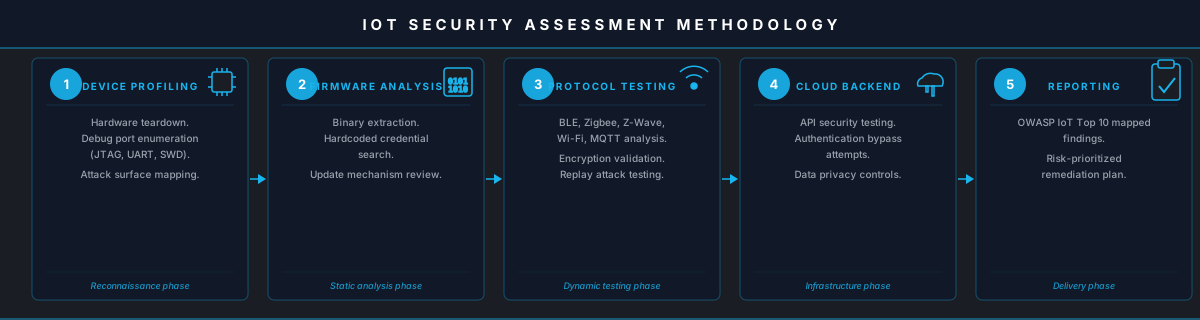
NYCF's IoT assessment begins at the device level and works outward through the full ecosystem: device hardware and firmware, local network communications, API interfaces, cloud backend services, and mobile companion applications. This full-stack approach is necessary because IoT vulnerabilities rarely exist in isolation. A device that uses strong TLS encryption for its cloud communications may still expose a UART debug interface that provides unauthenticated root shell access to anyone with physical proximity and a three-dollar serial adapter. An API that requires authentication for its primary endpoints may have undocumented administrative endpoints with no authentication at all.
Firmware analysis is a central component of any IoT assessment. NYCF uses binwalk and related tools to extract and analyze device firmware, examining the file system for hardcoded credentials, private keys, API tokens, sensitive configuration data, and known vulnerable software components. Where firmware cannot be obtained from the manufacturer or through standard update channels, NYCF performs hardware-level extraction using physical interface techniques, including JTAG boundary scan and UART serial console access, attaching to physical debug ports on the circuit board to extract the flash memory contents. This hardware-level capability is relevant both for security assessments and for IoT forensics, where extracting data from a physically damaged or security-locked device may be required in litigation.
Network traffic analysis captures all communications between the device and its ecosystem, including cloud servers, mobile apps, peer devices, and update infrastructure. NYCF examines this traffic for unencrypted credentials or sensitive data, certificate validation failures, protocol downgrades, and communications with unexpected endpoints that may indicate undisclosed data collection or a backdoor channel. API security testing covers both the device-facing and user-facing APIs, testing authentication and authorization controls, input validation, rate limiting, and access control enforcement across all available functions. Default credential checking is performed against all identified administrative interfaces, including web management panels, SSH and Telnet services, and device-specific management protocols. OTA update mechanism security is evaluated end-to-end, from the update server's certificate chain to the device-side verification logic.
Device Inventory and Discovery
All IoT devices in scope are catalogued, including device type, manufacturer, firmware version, and network presence. Shadow IoT devices not in any asset register are identified through network scanning.
Firmware Analysis
Firmware is extracted via binwalk or hardware interfaces (JTAG, UART) and analyzed for hardcoded credentials, private keys, vulnerable libraries, and undisclosed functionality.
Network Traffic and API Testing
Device communications are captured and analyzed for encryption weaknesses, certificate validation failures, and undisclosed data flows. API endpoints are tested for authentication bypass, injection, and authorization flaws.
Cloud Backend and Mobile App Review
Cloud infrastructure supporting the device ecosystem is reviewed for misconfiguration, exposed storage, and weak access controls. Companion mobile applications are assessed for insecure local storage and certificate pinning bypass.
Physical Interface Testing
JTAG, UART, serial ports, and other physical debug interfaces are tested for unauthenticated access. OTA update mechanisms are evaluated for signature verification and downgrade attack resistance.
IoT Forensics and Litigation Support
IoT devices have become a significant source of evidence in civil and criminal proceedings. Smart home devices including voice assistants, smart thermostats, connected door locks, and home security cameras generate logs and event records that can corroborate or contradict a party's account of events. Courts have admitted data from Amazon Echo devices, Fitbit wearables, and home security systems as evidence in homicide cases, domestic disputes, and personal injury matters. The legal framework for obtaining and authenticating this evidence is still developing, which makes the quality of forensic acquisition and chain-of-custody documentation particularly important for establishing admissibility.
Wearable device forensics is an area of growing relevance in both criminal proceedings and civil litigation. Fitness trackers and smartwatches record heart rate, activity levels, GPS location, sleep patterns, and physiological metrics with timestamps that can be precisely correlated to the events at issue. In personal injury litigation, this data can contradict claimed injury severity or activity limitations. In matrimonial proceedings, location data from wearables has been used to establish or refute claims about a party's whereabouts. NYCF's forensic acquisition of wearable device data follows established chain-of-custody procedures and produces reports that address the reliability of the acquired data, the completeness of the record, and the forensic integrity of the acquisition process.
Industrial IoT environments generate a distinct category of evidentiary data relevant to workplace incident proceedings, product liability claims, and insurance disputes. Sensor data from manufacturing equipment, process historians, and condition-monitoring systems can establish the precise sequence of events leading to an equipment failure or workplace injury with a level of temporal and technical detail that eyewitness testimony cannot match. NYCF's analysts extract, interpret, and present this data in a format accessible to the attorneys, legal teams, and courts directing the matter. For disputes where the security of an IoT deployment is itself at issue, whether a smart building system was compromised to facilitate a physical intrusion or whether an industrial IoT network was used as an attack vector, NYCF provides the forensic analysis and expert witness testimony that attorneys rely on to establish the technical facts of the incident.
Smart Home Device Forensics
Forensic acquisition of smart speakers, thermostats, door locks, and security cameras for criminal and civil proceedings. Chain-of-custody documentation supporting admissibility challenges.
Wearable Device Data in Litigation
Activity, location, heart rate, and physiological data from fitness trackers and smartwatches, forensically acquired and analyzed for personal injury, matrimonial, and criminal matters.
Industrial IoT Incident Analysis
Sensor data, process historians, and condition-monitoring records extracted and analyzed to support attorneys handling workplace incident proceedings, product liability claims, and equipment failure disputes.
Expert Witness on IoT Security Failures
NYCF analysts provide expert witness testimony on IoT security failures, breach causation, and the technical circumstances of incidents involving connected devices in civil and criminal proceedings.
IoT Penetration Testing
IoT security assessment identifies the vulnerabilities present in a device ecosystem. IoT penetration testing goes further, actively attempting to exploit those vulnerabilities to demonstrate what an attacker can actually achieve. NYCF's IoT penetration testing engagements cover the full technical stack, from device-level hardware exploitation through wireless protocol attacks, API compromise, and cloud backend testing, to establish a complete picture of what is realistically achievable for an attacker targeting the device environment.
Firmware extraction and analysis is the foundation of any device-level IoT penetration test. Obtaining the firmware image is itself a technical exercise: manufacturer-provided downloads are the starting point, but many devices do not provide firmware through official channels, require authentication to access update packages, or deliver encrypted firmware that must be decrypted before analysis. Where official acquisition fails, NYCF performs hardware-level extraction using physical interface techniques. JTAG boundary scan allows memory contents to be read directly from the device's processor. UART serial console access frequently yields a root shell or boot loader prompt that enables memory extraction without soldering. Flash chip extraction via SOIC clip or direct desoldering provides access to the raw memory contents for devices where other interfaces are locked or unavailable. Once extracted, firmware is analyzed for hardcoded credentials, private keys, API tokens, known vulnerable library versions identified through CVE databases, and undisclosed functionality that does not appear in the device's documentation.
Wireless protocol testing covers the full range of communication technologies used in IoT deployments. Zigbee, used in smart building systems and consumer home automation, can be captured and analyzed with commodity software-defined radio hardware. NYCF tests Zigbee deployments for weak encryption key configuration, insecure pairing procedures that allow rogue device association, and replay attacks against control messages. Bluetooth Low Energy (BLE) is ubiquitous in wearables, medical devices, and building access control systems. BLE testing covers pairing security, characteristic permission enforcement, man-in-the-middle susceptibility, and advertising data disclosure. LoRaWAN, used for long-range low-power sensor networks in industrial and smart city applications, is tested for join procedure security, device authentication, replay attack resistance, and downgrade conditions that expose unencrypted payloads.
MQTT and CoAP are the messaging protocols that carry the bulk of IoT data traffic. MQTT, a publish-subscribe protocol originally developed for satellite telemetry, is widely deployed without authentication or TLS encryption in internal IoT networks on the assumption that the network boundary provides sufficient protection. NYCF tests MQTT brokers for unauthenticated access, topic permission enforcement failures that allow one device to subscribe to another device's data channel, and broker configuration weaknesses including unrestricted topic publishing. CoAP, the Constrained Application Protocol used in low-power IoT devices, is tested for authentication weaknesses, DTLS implementation issues, and amplification attack potential in deployments facing external networks.
Cloud backend testing evaluates the server-side infrastructure that IoT devices communicate with. Most IoT platforms expose REST or MQTT APIs that handle device registration, data ingestion, command delivery, and user account management. NYCF tests these APIs for the full OWASP API Security Top 10: broken object level authorization, broken authentication, excessive data exposure, lack of resources and rate limiting, broken function level authorization, mass assignment, security misconfiguration, injection, improper asset management, and insufficient logging. Cloud storage buckets, databases, and message queues supporting the IoT platform are reviewed for misconfiguration, public access, and weak access controls that could expose device data or allow unauthorized command injection. Device shadow and digital twin services are tested for access control enforcement and state manipulation vulnerabilities.