Vehicle Electronic Evidence in New York Accident Litigation
The modern automobile is a networked collection of dozens of electronic control modules communicating across a shared data bus, each logging operational data that survives the collision event and can be accessed by qualified forensic examiners. New York's density of traffic, the volume of personal injury litigation arising from New York City accidents, and the specific regulatory environment covering TLC-licensed vehicles make vehicle forensics a significant practice area for New York personal injury, wrongful death, and product liability counsel. The data recovered from a vehicle's electronic systems often provides the most objective account of what happened in the seconds before and during a crash, unconstrained by witness memory, perception limitations, or adversarial framing.
New York State Vehicle and Traffic Law provides the legal framework for access to vehicle electronic data in litigation. Preservation demands for vehicle electronic evidence should be served as promptly as possible after an incident, because EDR data is stored in overwrite-capable memory that may be lost in subsequent power cycles or if the airbag control module is replaced. NYCF works with counsel to identify the appropriate timing and scope of preservation letters and court orders for vehicle evidence, and provides same-day vehicle examination services when the evidentiary timeline requires rapid action. For vehicles involved in significant New York City incidents, NYCF's Manhattan proximity is a practical advantage when the vehicle is in a Manhattan impound yard or at a collision repair facility accessible from the city.
The tri-state area geographic scope of NYCF's vehicle forensics practice reflects the reality of New York litigation. Significant incidents on the NJ Turnpike, the George Washington Bridge, the Cross Bronx Expressway, the Long Island Expressway, and the Hutchinson River Parkway all generate litigation with New York connections, whether because the plaintiff is a New York resident, the vehicle was registered in New York, or the case is filed in a New York court. NYCF's examinations extend across this geography, with examiners available for on-site vehicle examinations at locations throughout New York City, Long Island, Westchester, Connecticut, and New Jersey.
EDR Downloads and Event Data Recorder Analysis
The Event Data Recorder, which the National Highway Traffic Safety Administration regulates under 49 CFR Part 563, captures a defined set of vehicle parameters in a pre-crash recording buffer. Unlike the "black box" of an airliner, a vehicle EDR does not record continuously throughout a trip. Instead, it maintains a rolling buffer and writes a snapshot of vehicle state when a triggering event occurs, typically an airbag deployment or a deceleration event that meets a threshold criterion. The data stored in an EDR recording represents the vehicle's condition in the seconds before the trigger, providing a precise, time-stamped record of speed, throttle position, and braking status that is independent of any party's account of the incident.
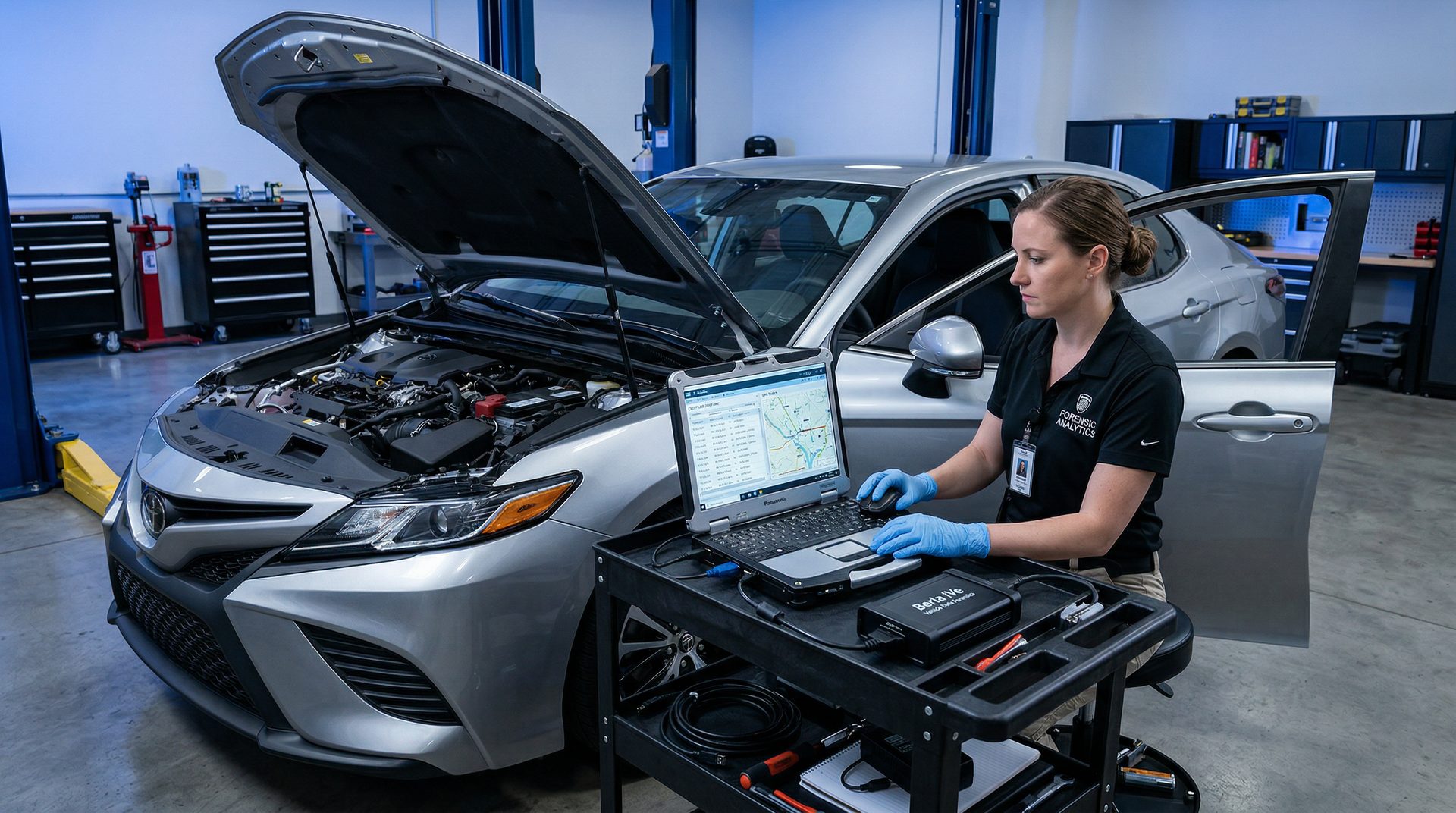
NYCF performs EDR downloads using the Bosch Crash Data Retrieval (CDR) tool, the industry-standard platform for accessing EDR data across domestic and foreign vehicle platforms. The CDR tool interfaces with the vehicle's OBD-II diagnostic port or directly with the airbag control module to read the stored event data. NYCF documents the complete acquisition process: the vehicle's VIN, the condition of the OBD port, the CDR tool hardware and software versions used, and the hash value of the resulting data file. The CDR report output is preserved in its native format and exported to PDF and CSV formats for use in litigation. Where the vehicle's EDR has recorded multiple events, each is separately documented and analyzed in the context of the incident timeline.
EDR data requires careful interpretation in the context of the specific vehicle model and the physical circumstances of the incident. Speed values in an EDR recording reflect wheel speed sensor data, which may not accurately reflect ground speed if wheels were locked during braking or if the vehicle was in a spin. Throttle position data distinguishes between driver-commanded throttle and actual throttle plate position, which is relevant in cases involving unintended acceleration allegations. Brake application status in pre-2013 model year vehicles is recorded as a binary on/off flag; in more recent vehicles, hydraulic brake pressure values are available for quantitative braking analysis. NYCF's reports contextualize EDR findings with reference to the specific vehicle's specifications and the known characteristics of the CDR platform for that vehicle make and model year.
Vehicle Identification and Preservation
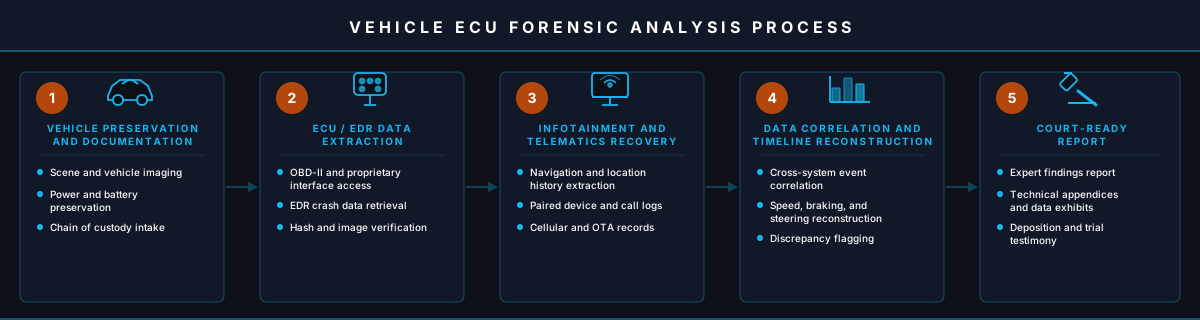
VIN documentation, physical inspection, and OBD port assessment establish the vehicle's identity and the scope of accessible electronic modules before any data acquisition begins.
EDR Download via CDR Tool
Forensic acquisition of EDR data using Bosch CDR hardware and software, following SAE J1698 standards. The examiner runs hash verification on all acquired data files.
ECU Module Interrogation
Beyond the EDR, additional ECUs including the transmission controller, stability control module, and body control module are queried for diagnostic trouble codes, freeze-frame data, and operational logs relevant to the incident.
Infotainment and Telematics Extraction
Navigation history, paired device records, call logs, location waypoints, and Bluetooth connection data are extracted from the infotainment system using Berla iVe or equivalent automotive forensic platforms.
Report and Expert Testimony
A comprehensive forensic report documents all findings with litigation-quality supporting data. Expert testimony is available for New York personal injury, wrongful death, and product liability proceedings.
Infotainment Forensics and Connected Vehicle Data
The infotainment system in a modern vehicle is a forensic gold mine for New York personal injury and criminal defense practitioners. These systems record GPS track logs with timestamps and speed data, the complete history of Bluetooth-paired devices including every phone that has ever connected to the vehicle, call logs from phone calls placed through the vehicle's hands-free system, navigation destination history, media playback records, and in many vehicles, the location and time of every ignition cycle. This data persists across vehicle power cycles in non-volatile memory and survives vehicle damage that would disable other electronic systems, including airbag deployments that trigger the EDR.
NYCF uses the Berla iVe platform, which supports forensic acquisition from over 15,000 vehicle models, to extract and decode infotainment system data from the vehicles most commonly encountered in New York litigation. For vehicles not supported by iVe, NYCF uses alternative automotive forensic tools and, where necessary, chip-off extraction from the infotainment system's storage media. The GPS track log from a vehicle involved in a New York City incident can place the vehicle at specific intersections with timestamp accuracy that exceeds what traffic cameras or witness memory can provide. For criminal matters, GPS data from a suspect vehicle can independently corroborate or contradict cell tower location evidence presented by the prosecution.
The smartphone connection history recorded in a vehicle's infotainment system is particularly valuable in New York distracted driving cases. When a driver denies using a phone at the time of a collision, the vehicle's Bluetooth connection log provides an independent record of the connection status between the driver's phone and the vehicle. A phone connected via Bluetooth that was actively engaged in a call at the time of the incident produces a connection log entry in the infotainment system that cannot be altered without physical access to the vehicle's storage media. NYCF coordinates infotainment forensics with mobile device forensics for matters where both the vehicle and the driver's phone are available for examination, producing a correlated timeline from both evidence sources that is more complete than either alone.
For fleet vehicles, rideshare vehicles, and TLC-licensed vehicles operating in New York City, telematics data from fleet management systems provides a continuous GPS and operational data record that extends well beyond the vehicle's internal storage. Systems like Samsara, Geotab, and Verizon Connect store GPS position, speed, acceleration events, harsh braking incidents, and vehicle status data on remote servers, often with retention periods of several months. NYCF works with counsel to identify the relevant telematics provider, serve appropriate preservation demands, and analyze the resulting data in conjunction with the vehicle's on-board electronic evidence.
GPS Track Log Recovery
Navigation history and GPS waypoint extraction from infotainment systems to establish the vehicle's route, speed, and location at specific timestamps relevant to the incident.
Paired Device and Call Log Analysis
Recovery of Bluetooth-paired phone history, call records through hands-free system, and device connection status at the time of incident for distracted driving analysis.
Fleet Telematics Analysis
Recovery and analysis of telematics data from fleet management systems for TLC vehicles, commercial trucks, and corporate fleet vehicles involved in New York incidents.
CAN Bus Post-Incident Analysis
Examination of Controller Area Network bus logs for detailed vehicle system state data beyond the EDR record, including subsystem-level behavior during the incident sequence.
NYC Traffic Incidents, TLC Vehicles, and New York Personal Injury Practice
New York City generates more personal injury litigation from vehicle incidents than any comparable geographic area in the country. The combination of dense traffic, cyclist and pedestrian volumes, TLC-regulated commercial vehicles, and delivery fleets creates an incident environment unlike suburban or highway settings. Manhattan's grid, where crosswalk timing, one-way streets, and loading zone restrictions all affect driver behavior, means that understanding vehicle electronic data in the context of New York City traffic conditions requires familiarity with both the forensic tools and the local environment.
NYC TLC vehicles are subject to specific regulatory requirements that affect the available electronic evidence. Many yellow taxi and green cab vehicles are equipped with the Taxicab Technology System (TaxiCab) or equivalent systems that record GPS position, passenger load status, and meter operation continuously. For-hire vehicle operators, including Uber and Lyft drivers, are monitored through the rideshare platforms' internal telematics, which record GPS position, speed, and trip data on the platform's servers. When a TLC vehicle is involved in a significant incident, NYCF assists counsel in identifying and preserving both the vehicle's on-board electronic evidence and the platform telematics data that the rideshare company holds.
New York's comparative fault framework under CPLR Article 14-A means that the allocation of fault between parties in a multi-vehicle incident has direct financial significance. Vehicle forensic data that establishes each vehicle's speed, braking status, and steering inputs in the seconds before impact provides the factual basis for the comparative fault analysis. NYCF's EDR and ECU reports are structured to present these findings in the format that accident reconstruction experts need to integrate electronic data with physical evidence from the scene, producing a technically complete account of the incident mechanics. NYCF coordinates regularly with accident reconstruction engineers in the New York area for matters where physical reconstruction and electronic data analysis need to be presented as an integrated expert opinion.
Product liability claims against vehicle manufacturers in New York courts require forensic documentation of vehicle behavior that goes beyond what eyewitness testimony can establish. Alleged unintended acceleration, brake system failure, stability control malfunction, and defective airbag deployment are among the product liability theories that ECU and EDR forensic analysis can directly address. NYCF's vehicle forensic reports in product liability matters address the specific electronic evidence bearing on the claimed defect, including whether diagnostic trouble codes consistent with the claimed failure were present before the incident, whether the vehicle's electronic systems behaved as designed during the incident sequence, and what the vehicle's data shows about the driver's inputs in the period before the incident. Contact NYCF at (212) 561-5860 or info@digitalforensics-newyork.com to discuss vehicle forensic requirements for your matter.
Electric Vehicles, Autonomous Systems, and Emerging Vehicle Data
The shift to electric vehicles and the introduction of advanced driver assistance systems (ADAS) in the New York vehicle fleet is creating new categories of vehicle forensic evidence. Electric vehicles carry battery management system (BMS) logs that record cell-level voltage, temperature, and current data with millisecond resolution throughout the vehicle's operational history. BMS data is relevant in EV fire litigation, battery warranty disputes, and product liability matters involving battery performance. For EVs involved in New York accidents, the BMS log provides a continuous operational record that supplements the EDR data, often with higher temporal resolution and a longer pre-incident window than the EDR captures.
ADAS systems in vehicles equipped with automatic emergency braking, lane departure warning, and adaptive cruise control generate their own sensor data logs. When an ADAS system activates or fails to activate in the circumstances of a New York accident, the sensor log from the camera, radar, and lidar systems involved provides technically rich evidence about the environment the vehicle perceived and the system's response. This data is becoming increasingly significant in litigation involving questions about whether a driver could have avoided an accident, whether the vehicle's safety systems performed correctly, and in early autonomy cases, whether the automated driving system made an appropriate decision given the available sensor information.
For vehicles involved in criminal matters in New York, including vehicular homicide prosecutions in state court and carjacking and vehicle theft cases, the forensic record from the vehicle's electronic systems can corroborate or undermine the prosecution's account of the incident. NYCF provides vehicle forensic analysis for criminal defense teams in New York County, Kings County, Queens County, Bronx County, and Richmond County courts, as well as for SDNY and EDNY federal criminal matters where vehicle electronic evidence is relevant. The chain of custody documentation and examiner qualifications that NYCF provides are consistent with the requirements for expert testimony in New York criminal proceedings under the standards applicable to novel scientific evidence.