
Enterprise IT Infrastructure as a Source of Evidence
When a New York attorney confronts a matter involving data theft, a security breach, financial fraud, or an employment dispute with a digital dimension, the evidence trail runs through enterprise IT infrastructure. Individual computers and phones contain part of the record, but the servers, directory services, email platforms, cloud environments, and databases that make up enterprise IT contain the broader context: who accessed what, when, from where, and through which systems.
NYCF's IT forensics practice is built specifically around the enterprise environments found in New York's financial services, legal, healthcare, media, and corporate sectors. The firm's analysts have extensive experience with the specific technology stacks, compliance frameworks, and regulatory environments that New York businesses operate within, and they produce findings calibrated to the evidentiary expectations of New York state courts, the Southern and Eastern Districts, and federal regulatory bodies.
For matters that also require analysis of individual endpoints, NYCF's cyber forensics team works alongside the IT forensics practice to provide a comprehensive view. Where network traffic records are needed to complement infrastructure findings, our network forensics capability addresses that layer of evidence.
What NYCF Examines in IT Forensics Engagements
Each platform and system category in an enterprise IT environment presents its own artifacts, log structures, and forensic challenges. NYCF's analysts work across all of them:
Windows Server and Endpoint Artifacts
Registry hives (NTUSER.DAT, SYSTEM, SOFTWARE, SECURITY, SAM) are examined for user activity, program execution history, USB connections, mapped drives, and persistence mechanisms. Event logs including Security, System, PowerShell Operational, and WMI Activity logs document logon events, privilege use, process creation, and account management. Prefetch files, ShimCache, Amcache, and BAM/DAM entries establish program execution timelines. Shell artifacts (LNK files, Jump Lists, ShellBags) record recent file and folder access.
Active Directory and Identity Services
In breach and insider threat matters, Active Directory is often the central evidence source. NYCF examines AD event logs for account creation, group membership changes, privilege escalation, Kerberos ticket activity, and LDAP reconnaissance queries. The NTDS.DIT database provides replication metadata with account history and attribute modification timestamps that survive log rotation. For Azure AD (Entra ID) environments, sign-in logs, conditional access evaluations, and administrative activity records are collected and examined.
Email Systems and Collaboration Platforms
NYCF performs forensic collection and examination of Exchange Server (on-premises), Microsoft 365 Exchange Online, and Google Workspace. Mailbox stores, transport logs, message tracking records, and administrative audit logs document sent, received, and deleted messages; forwarding rules; non-owner mailbox access; and delivery path reconstruction. For Microsoft 365 tenants, Unified Audit Log records capture user and administrator activity across Exchange, SharePoint, OneDrive, and Teams.
Cloud Platforms and Virtualization
NYCF collects from AWS (CloudTrail, S3 access logs, IAM records), Azure (Activity Logs, Monitor, Resource Logs), and Google Cloud (Audit Logs, Access Transparency). For VMware vSphere and Microsoft Hyper-V, virtual machine snapshots, vCenter event logs, and ESXi host logs reconstruct activity in virtualized server environments. All cloud evidence is preserved with documented chain of custody and cryptographic hash verification, following the same rigor applied to physical media.
Databases and Enterprise Applications
NYCF examines transaction logs, access records, backup catalogs, and replication logs for SQL Server, Oracle, MySQL, PostgreSQL, and MongoDB. Enterprise application logs from ERP systems (SAP, Oracle E-Business Suite), CRM platforms (Salesforce), financial systems, and HR systems document user activity, data access, and record modifications in terms directly relevant to the legal questions at issue.
IT Forensics for New York Legal Matters
The legal matters that drive IT forensics engagements in New York follow patterns shaped by the jurisdiction's concentration of financial services, corporate headquarters, and regulatory bodies:
Insider Threat and Data Theft
When an employee departs with proprietary data, NYCF examines the enterprise systems that recorded the activity: file server access logs, email metadata, cloud sync client records, DLP system alerts, USB connection artifacts, and VPN session records. The resulting findings document what was taken, how, and when, providing the factual foundation for trade secret, non-compete, and breach-of-duty claims under New York and federal law.
Breach Documentation and Regulatory Response
Post-incident forensic documentation is required for breach notification under the New York SHIELD Act, HIPAA, GLBA, and state-specific statutes. Our forensic team reconstructs the attacker's path through enterprise infrastructure, documents the systems and data affected, and produces the technical record that counsel needs for notification decisions, insurance claims, and regulatory submissions to HHS OCR, New York DFS, the SEC, and FINRA.
Employment Disputes with Digital Evidence
Non-compete enforcement, wrongful termination defense, harassment claims, and discrimination proceedings frequently involve evidence preserved in enterprise IT systems. NYCF's examination of email archives, file access records, HR system logs, and collaboration platform data provides the documented digital record that both plaintiffs and defendants in New York employment matters rely on.
Fraud and Financial Record Reconstruction
Financial fraud matters require reconstruction of accounting system activity, ERP record modifications, email communications, and document metadata. NYCF examines the enterprise systems where these records live, documenting what was created, modified, or deleted, by which user account, and at what time. These findings provide the digital evidentiary foundation for forensic accountants and attorneys in embezzlement, procurement fraud, and financial statement fraud matters.
Evidence Acquisition and Defensible Methodology
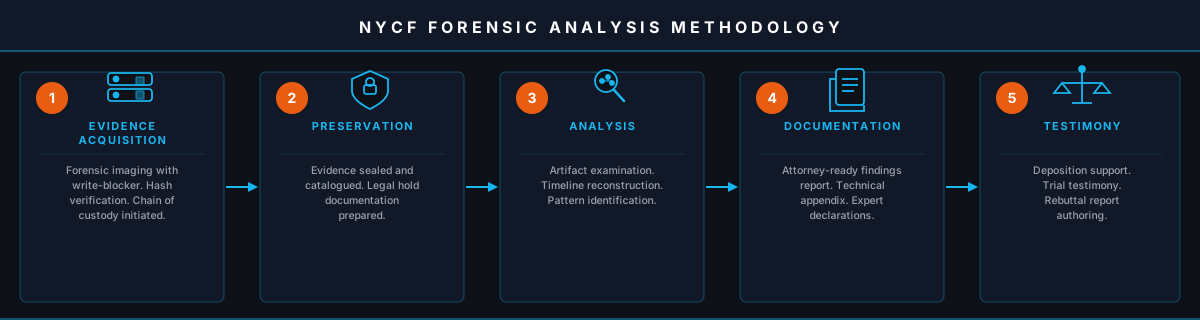
Forensic examination follows NIST SP 800-86, SWGDE guidelines, and ISO/IEC 27037 for digital evidence identification, collection, and preservation. For physical media, forensic imaging uses hardware write-blocked acquisition with industry-standard tools, producing E01 or raw DD images verified with MD5 and SHA-256 hash values. For live systems where shutdown would destroy volatile evidence or disrupt business operations, NYCF performs live forensic acquisition of running memory, active process state, and network connections before proceeding to disk imaging.
Cloud evidence acquisition uses platform-native collection methods documented for chain-of-custody purposes: Microsoft 365 Content Search and eDiscovery exports, AWS CloudTrail and S3 inventory exports, Azure Activity Log and Monitor data exports, and Google Workspace Vault collections. The API calls, tool versions, and resulting data hashes are recorded to establish the defensibility of cloud-sourced evidence in New York proceedings.
Anti-forensic detection receives specific attention in every engagement. NYCF's analysts document evidence of log clearing, timestamp manipulation (timestomping), secure deletion tool usage, bash history deletion, and other concealment activity. These findings are themselves significant evidence in insider threat, fraud, and breach matters and are reported with the same rigor as primary forensic findings.
NYCF's IT forensics analysts are available for deposition and trial testimony throughout New York. They hold CCE, EnCE, ACE, GIAC GCFE, and ACFEI International certifications recognized by federal and state courts, and have experience explaining complex enterprise IT forensic findings to non-technical judges, juries, and arbitration panels. For matters that also require ESI collection and production, NYCF's eDiscovery practice can be engaged concurrently with the IT forensics team.