New York as the Center of AI Forensics Demand
No city in the United States has moved more aggressively to regulate artificial intelligence than New York. The combination of NYC Local Law 144 on automated employment decisions, the New York State Attorney General's active enforcement posture on AI-related consumer harm, the NY Department of Financial Services circular letters on AI governance for insurers, and the SEC and FINRA examination programs covering algorithmic trading and robo-advisory systems means that New York law firms need AI forensic analysis capabilities that no other city's legal market requires to the same degree.
NYCF's AI forensics practice addresses this regulatory environment directly. Unlike general digital forensics, AI forensics requires examiners who understand how machine learning systems are built, trained, and evaluated: what model architecture means for interpretability, how training data characteristics propagate into model outputs, what fairness metrics measure and what their limitations are, and how to document an AI system's decision logic in terms that are meaningful to regulators, judges, and juries. NYCF's examiners combine formal training in machine learning with forensic methodology, producing analysis that is both technically credible and legally usable.
The forensic examination of an AI implementation is fundamentally different from examining a traditional software system. A conventional program executes a defined set of instructions that can be reviewed line by line. A machine learning model produces outputs through a numerical optimization process over potentially billions of parameters, and the relationship between any specific input and the resulting output is not a matter of code review but of mathematical analysis of weight matrices, activation functions, and learned representations. NYCF's analytical approach addresses this challenge through a combination of input-output behavioral testing, attention and attribution analysis, and statistical characterization of output distributions across population subgroups, producing findings that are both technically accurate and explainable to legal audiences.
Deepfake Detection and Synthetic Media Forensics
Synthetic media, including AI-generated video, audio, and images, presents a genuine evidentiary challenge to New York courts. A deepfake video of a business executive appearing to authorize a fraudulent wire transfer, fabricated audio of a defendant making an incriminating statement, or manipulated photographs presented in a family court proceeding are not hypothetical concerns but documented fraud patterns that have appeared in New York litigation. Criminal defense counsel have faced government evidence that defense teams have reason to question. Plaintiffs in defamation and non-consensual intimate image cases present synthetic media as evidence of harm. The threshold question in all of these matters is authentication: is this content what it purports to be?
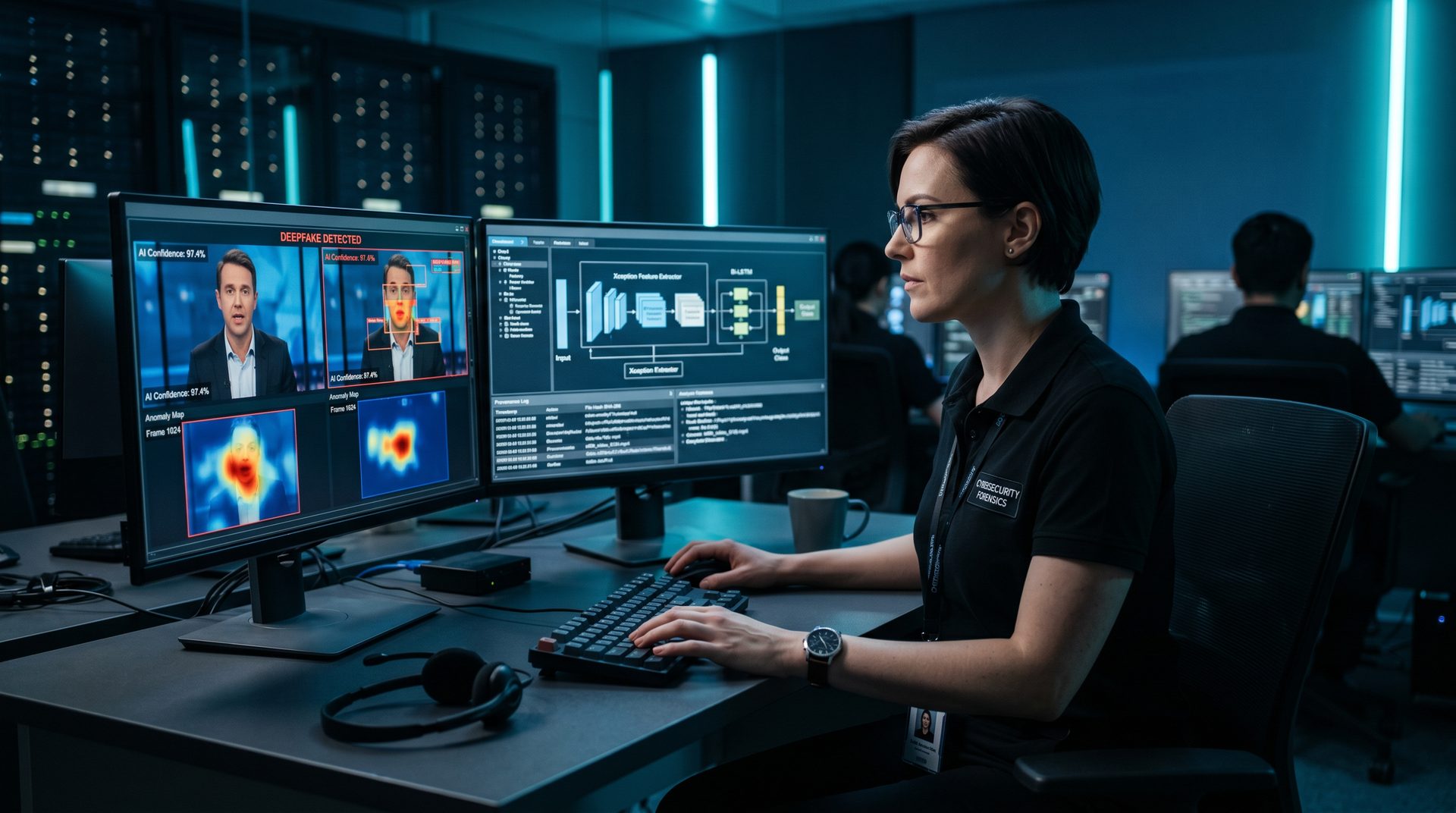
NYCF's deepfake detection analysis applies a multi-technique framework that addresses the range of generative AI methods in current use. Physiological signal analysis examines whether the video content contains coherent biological signals: a real human face in video exhibits subtle but measurable blood flow patterns (photoplethysmography signals) across the facial surface that change consistently with heartbeat timing. Current generative adversarial network (GAN) and diffusion model outputs generally do not replicate these physiological signals coherently, producing characteristic anomalies in the temporal domain that distinguish synthetic from authentic video. NYCF applies computational PPG analysis to video evidence as one component of a broader examination.
Compression artifact analysis exploits the characteristic signature that video encoding leaves in authentic versus synthetic content. A genuine video recording from a smartphone or camera will have compression artifacts that are consistent with the claimed recording device's codec and settings, distributed across the image in patterns that reflect the natural spatial statistics of real scenes. A deepfake video generated at high resolution and then compressed for distribution will show characteristic double-compression artifacts, inconsistencies in the quantization noise floor, and spatial patterns in the discrete cosine transform coefficients that differ from authentic single-compression recordings. These artifacts are not visible to the naked eye but are measurable through spectral and statistical analysis of the compressed bitstream.
Geometric and rendering coherence analysis examines the three-dimensional consistency of facial geometry across video frames, the consistency of specular highlights on skin and eyes with the implied lighting environment, and the alignment of shadows with the light sources visible in the background of the frame. Current deepfake generation methods produce faces that are locally plausible frame-by-frame but may exhibit geometric drift over longer sequences or inconsistencies at the boundaries between the generated face region and the authentic background. For audio deepfakes, formant analysis, spectral envelope examination, and prosodic pattern analysis provide analogous indicators of synthetic generation. NYCF documents each detection technique applied, the specific findings from that technique, and the aggregate technical basis for the overall assessment of the content's authenticity.
Content Acquisition and Hash Documentation
The media file is received with documented chain of custody. Cryptographic hash values are recorded to establish the exact content submitted for analysis, supporting authentication at trial.
Physiological Signal Analysis
Computational photoplethysmography analysis of facial video to detect the presence or absence of coherent biological signals that distinguish authentic from synthetically generated video.
Compression and Spectral Analysis
Examination of video compression artifacts, quantization patterns, and frequency domain characteristics for signatures of synthetic generation or double-compression re-encoding.
Geometric and Rendering Coherence
Frame-by-frame analysis of facial geometry consistency, lighting coherence, shadow alignment, and GAN-characteristic artifacts at face-background boundaries.
Expert Report and Testimony
A technical report documents all detection methodologies applied, specific findings, and the forensic basis for the authenticity assessment. Expert testimony is available for New York state and federal proceedings.
NYC Local Law 144 and Automated Employment Decision Audits
New York City's Local Law 144 represents the most specific AI accountability requirement enacted by any American city. Employers using automated employment decision tools in hiring or promotion decisions affecting New York City candidates or employees must conduct an independent bias audit at least annually, publish the results, and notify affected job candidates of the use of such tools. The NYC Department of Consumer and Worker Protection has begun enforcement and has issued guidance on what a compliant bias audit must contain. The legal community in New York is only beginning to understand the litigation exposure that Local Law 144 creates for employers who fail to conduct proper audits or whose audit results reflect bias in their hiring tools.
NYCF's Local Law 144 bias audit examinations follow the statistical framework specified in the law and the interpretive guidance issued by DCWP. The core analytical requirement is calculation of the selection rate for each race and ethnicity subgroup and each sex category relative to the most selected group, using a dataset that meets minimum sample size requirements. Where the resulting impact ratio falls below the four-fifths rule threshold traditionally used in employment discrimination analysis, the audit result reflects adverse impact that must be disclosed. NYCF's analysis goes beyond the minimum statistical calculation to document the model features and decision weights that contribute to any identified disparate impact, providing employers and their counsel with the technical basis for understanding and remedying adverse impact findings.
The intersection of Local Law 144 and New York Human Rights Law creates an important litigation context. An employer's Local Law 144 audit result documenting adverse impact in a hiring tool is potentially admissible evidence in a discrimination claim under the New York City Human Rights Law, which is among the most expansive anti-discrimination statutes in the country. NYCF's analysis supports both the employer's compliance posture and, where discrimination claims are filed, the factual record that counsel needs to assess exposure and develop defense strategy. For plaintiffs' counsel, NYCF's independent examination of an employer's AEDT can provide technical evidence that a challenged hiring tool produced adverse impact not reflected in a self-serving prior audit.
Local Law 144 Independent Bias Audits
Statistical analysis of automated employment decision tools for disparate impact across race, ethnicity, and sex categories per NYC DCWP requirements, with publishable audit reports.
Feature Attribution Analysis
Examination of model feature weights and decision contributions to identify which inputs drive adverse impact findings, informing remediation strategy for employers.
Plaintiff-Side AEDT Examination
Independent forensic examination of an employer's automated hiring tool for plaintiffs' counsel in NYC Human Rights Law and Title VII discrimination claims.
DCWP Enforcement Response Support
Technical documentation and expert support for employers responding to NYC DCWP enforcement inquiries related to Local Law 144 compliance obligations.
Wall Street AI Compliance: Financial Services AI Forensics
New York's financial services sector is the largest concentration of AI deployment in any single industry in the world. The major investment banks headquartered in Midtown Manhattan use machine learning for algorithmic trading, credit risk modeling, fraud detection, client suitability analysis, and increasingly for hiring and employee monitoring. The regulatory scrutiny applied to these systems spans multiple agencies: the NY DFS, which has issued circular letters on AI governance for insurers and signaled increasing attention to bank AI practices; the SEC and FINRA, which have examination programs covering robo-advisory services and algorithmic trading; the CFPB, which has enforcement authority over AI-driven credit decisions that affect New York consumers; and the Federal Reserve, which applies SR 11-7 model risk management guidance to models used by banks it supervises.
NYCF's financial services AI forensic analysis addresses two distinct client scenarios. For financial institutions responding to regulatory examination requests or enforcement inquiries, NYCF provides technical analysis of the institution's AI systems that supports a factually accurate and complete response to the regulator's questions. Model documentation, training data provenance, validation results, and performance monitoring records are assembled and analyzed to produce a technically defensible account of how the system functions and how it has been governed. Where the regulator's concern focuses on a specific decision or class of decisions produced by the AI system, NYCF analyzes the specific inputs and model states relevant to those decisions.
For litigation involving Wall Street AI systems, NYCF provides forensic analysis that supports counsel on both sides of disputes arising from algorithmic decisions. A hedge fund litigating against an algorithmic trading counterparty over trade execution quality may need a technical analysis of the counterparty's execution algorithm to establish whether it behaved as specified. A class action against a bank alleging algorithmic discrimination in mortgage underwriting requires statistical analysis of the model's output distribution across demographic groups combined with technical examination of the model's feature set and training data. A whistleblower matter involving a financial institution's AI system requires forensic preservation and analysis of model artifacts, training data, and validation records in a manner that preserves their use in subsequent SEC or DOJ proceedings. NYCF's financial AI forensic practice has direct relevance across all of these contexts.
AI Model Auditing: Training Data and Algorithmic Decision Logic
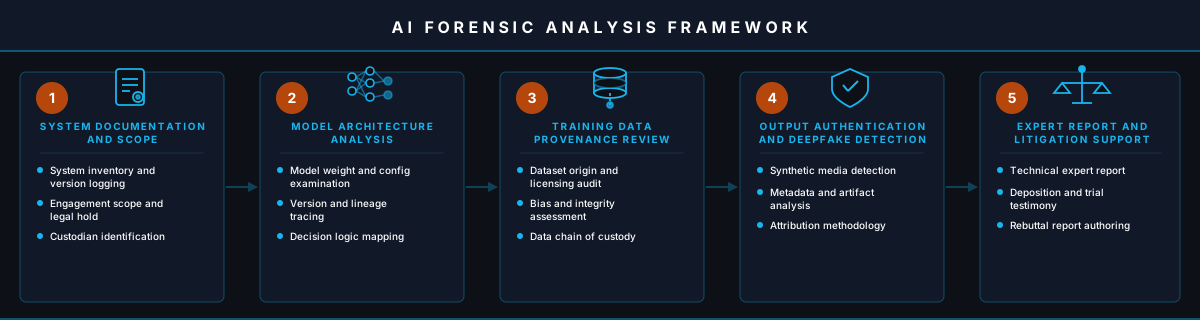
Understanding how an AI model makes decisions requires access to three components: the model architecture and trained weights, the training data that produced those weights, and the evaluation framework used to assess the model's performance. In litigation and regulatory contexts, one or more of these components is typically the subject of a discovery dispute or a regulatory request, and NYCF's forensic analysis addresses the technical questions that arise at each level.
Training data analysis examines the dataset used to train a model for characteristics that bear on the model's outputs. A hiring model trained on historical hiring decisions that reflected past discrimination will learn to replicate that discrimination, even if none of the model's explicit features include race or sex. This is the phenomenon of proxy discrimination: the model uses features that correlate with protected characteristics, such as zip code, school name, or graduation year, to produce discriminatory outcomes without any explicit discriminatory instruction. NYCF's training data analysis characterizes the demographic composition of training datasets, tests for correlation between protected characteristics and features used by the model, and examines the historical selection rates embedded in the training labels to identify conditions that could produce proxy discrimination in the trained model.
Model architecture and weight examination addresses how the model's learned representation responds to different inputs. For a neural network, attribution analysis using techniques such as SHAP (SHapley Additive exPlanations) or integrated gradients identifies which input features contribute most heavily to specific outputs and how feature contributions vary across the input space. For a decision tree or gradient boosting model, the decision logic can be extracted and examined directly to identify feature split points, path probabilities, and the leaf-node distributions that determine outputs for specific input combinations. For black-box models provided only as APIs without access to internal structure, NYCF applies behavioral testing through structured input perturbation to characterize model sensitivity and identify decision boundaries that bear on the legal question at issue.
Output distribution analysis characterizes the model's behavior across the relevant population by examining the statistical distribution of outputs across demographic subgroups, performance tiers, or other relevant categorical variables. For New York employment law matters, this analysis produces the impact ratio calculations required by Local Law 144 and the adverse impact analysis applied in Title VII disparate impact claims. For financial services matters, output distribution analysis documents selection rate disparities in credit underwriting, pricing, or service provision across race, national origin, and other protected classes covered by the Equal Credit Opportunity Act and the New York City Human Rights Law. The statistical methodology and the confidence intervals associated with each finding are documented in detail sufficient for expert testimony under Federal Rule of Evidence 702 and the Daubert standard applied in SDNY and EDNY proceedings.
NY AG AI Enforcement and New York State AI Regulation
The New York State Attorney General has demonstrated active interest in AI-related consumer harm, with prior enforcement actions addressing AI-generated misinformation, algorithmic discrimination in housing and employment, and AI-enabled fraud. As New York State continues to develop its AI regulatory framework, the AG's office has broad authority under Executive Law Section 63(12) and General Business Law Article 22-A to address AI implementations that cause harm to New York residents, creating enforcement exposure for New York employers and businesses that is distinct from the federal regulatory picture.
NYCF's AI forensic analysis supports New York companies and their legal counsel in preparing for and responding to NY AG inquiries involving AI systems. Where the AG's investigation focuses on an alleged pattern of discriminatory outcomes from an AI system, NYCF provides independent technical analysis that either confirms the technical basis for the concern or identifies flaws in the methodology underlying the allegation. The technical analysis informs counsel's assessment of the company's exposure and positions the client to engage substantively on the technical merits of the AG's factual claims.
For companies facing civil litigation under New York state law related to AI systems, NYCF provides expert forensic analysis addressing the specific claims at issue. The New York City Human Rights Law's provisions on algorithmic discrimination in employment, housing, and public accommodations are among the broadest in the country. Class action practitioners in New York have begun to apply these provisions to AI systems used by employers and landlords, creating a litigation environment where technically grounded forensic analysis of the challenged system's decision logic and output distribution is essential to the defense. NYCF's examiners are available for deposition, Daubert hearings, and trial testimony in New York state and federal court matters. Contact NYCF at (212) 561-5860 or info@digitalforensics-newyork.com to discuss the technical aspects of your AI-related legal matter.