IC Forensics in New York Litigation
Integrated circuit forensics addresses a class of technical questions that arise with increasing frequency in New York commercial litigation. As electronics become embedded in every product category from medical devices to consumer appliances to automotive systems, disputes over chip failure, IC design ownership, and counterfeit components reach New York courts through patent infringement filings in the Southern District, product liability claims in New York Supreme Court, and contract disputes before the Commercial Division. The answers to these disputes often depend on physical evidence at the microscopic or sub-microscopic scale: the layout of transistors on a die, the elemental composition of bond wire material, or the presence of remarking on a chip package.
New York's position as a hub for financial services technology, medical device companies, defense contractors with offices in the metro area, and electronics distributors operating through the Port of New York makes IC forensics a recurrent need in the city's legal market. A Manhattan-based hedge fund disputing the performance characteristics of custom trading ASICs, a Long Island medical device manufacturer facing a product liability claim over an implantable electronics failure, and a New York defense contractor managing a supply chain dispute over potentially counterfeit microcontrollers each present the same fundamental need: technically credible forensic analysis of the component itself, conducted by examiners who can translate findings for legal audiences.
NYCF's IC forensic practice draws on a multi-technique analytical framework aligned with ISO/IEC 17025 laboratory standards and the JEDEC failure analysis methodologies applicable to semiconductor components. Each examination is documented with the specificity required for expert witness testimony, and NYCF's examiners have testified in SDNY patent cases, New York state product liability trials, and arbitration proceedings before FINRA and ICC panels seated in New York. The work product from IC forensic examinations is coordinated through retaining counsel to maintain appropriate privilege protections throughout the litigation process.
Non-Destructive Analysis Techniques
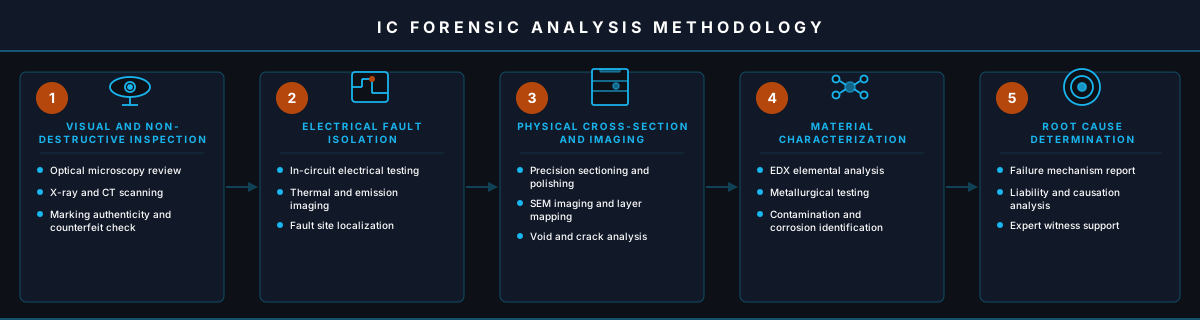
NYCF's IC forensic examinations begin with non-destructive techniques that document the component's external and internal condition without altering it. This sequencing is essential in litigation contexts: parties opposing a forensic examination have a legitimate interest in ensuring that evidence is not altered before they have an opportunity to observe or conduct their own testing, and courts have sanctioned parties who destroyed evidence through premature destructive testing without adequate notice. Non-destructive analysis not only preserves the examination object but frequently answers the key forensic questions without any destructive steps at all.
Optical inspection at high magnification documents the package exterior, lead finish condition, date code and lot code markings, surface texture, and any signs of remarking, blacktopping, or re-branding. Authentic integrated circuits from established manufacturers have consistent marking characteristics that are well-documented in their datasheets and application notes. Counterfeit components frequently exhibit sanded surfaces where original markings were removed before new markings were laser-etched, inconsistent font characteristics compared to authentic specimens, and lead finish conditions inconsistent with the claimed manufacturing date. NYCF maintains reference libraries of authentic component markings for comparison purposes.
X-ray fluoroscopy provides a non-destructive view of the internal die and package construction without requiring chemical decapsulation. X-ray imaging reveals the die size and position within the package, the wire bond connections from die pads to package leads, internal structural anomalies such as voids in die attach adhesive or delamination at package interfaces, and in some cases can identify die designs inconsistent with the claimed part number. X-ray imaging is particularly valuable for identifying remarked parts where the internal die is from a different product family than the package marking claims, a common counterfeit technique for high-value automotive and defense-grade parts.
Acoustic microscopy, also called C-mode scanning acoustic microscopy (C-SAM), uses focused ultrasound to image the internal interfaces of an IC package. This technique is uniquely sensitive to delamination between the die and die attach material, moisture-induced popcorning, and internal cracks that are not visible on X-ray. Delamination documented by acoustic microscopy is often the root cause in product liability matters involving component failure during reflow soldering or in-service thermal cycling. The C-SAM images produced by NYCF provide a two-dimensional map of interface condition that is directly relatable to the physical package dimensions, enabling precise characterization of the spatial extent of any anomalies found.
Electrical characterization through curve tracing, functional testing, and parametric measurement documents the component's electrical behavior before any physical alteration. For components claimed to have failed, pre-decapsulation electrical characterization establishes the failure mode at the device level, which guides the subsequent physical failure analysis by identifying which circuit elements are the likely site of failure. For counterfeit detection, electrical testing identifies parts that are out-of-specification for critical parameters, including leakage current, threshold voltage, and timing characteristics, providing a performance-based indicator of counterfeiting that complements the physical analysis.
External Optical Inspection
High-magnification visual documentation of package markings, lead finish, surface condition, and any indicators of remarking or re-branding compared against authentic reference specimens.
X-ray Fluoroscopy
Non-destructive internal imaging of die dimensions, wire bond layout, and package construction to identify internal anomalies and cross-check claimed part identity against known die configurations.
Acoustic Microscopy
C-SAM imaging of internal package interfaces to detect delamination, voids, and moisture damage that may be the root cause of field failure or assembly process yield loss.
Electrical Characterization
Curve tracing and parametric testing against datasheet specifications to document the failure mode at the device level before physical failure analysis begins.
Destructive Analysis: SEM/TEM, FIB Cross-Sectioning, and Material Characterization
When non-destructive analysis has established the examination framework and all necessary documentation has been completed, NYCF proceeds to destructive techniques that provide direct access to the IC's internal structure. These techniques are irreversible and must be coordinated with counsel before proceeding in any matter where opposing parties have preservation rights in the evidence. NYCF provides written notification protocols and scheduling procedures that enable all parties with an interest in the evidence to observe destructive examination steps, consistent with the requirements of New York state courts and federal court practice in SDNY and EDNY matters.
Decapsulation opens the IC package to expose the die surface for direct examination. Chemical decapsulation uses concentrated acids under controlled conditions to remove the plastic molding compound without damaging the die or wire bonds. Plasma decapsulation is available for sensitive components where chemical exposure might alter surface features relevant to the examination. Once the die surface is exposed, NYCF performs optical and scanning electron microscope (SEM) examination of the die layout, visible circuit structures, and any surface anomalies including electrostatic discharge (ESD) damage sites, dielectric breakdown locations, metal migration, or corrosion. SEM examination at multiple magnification levels produces a complete record of the die condition that supports both patent claim mapping and failure mode identification.
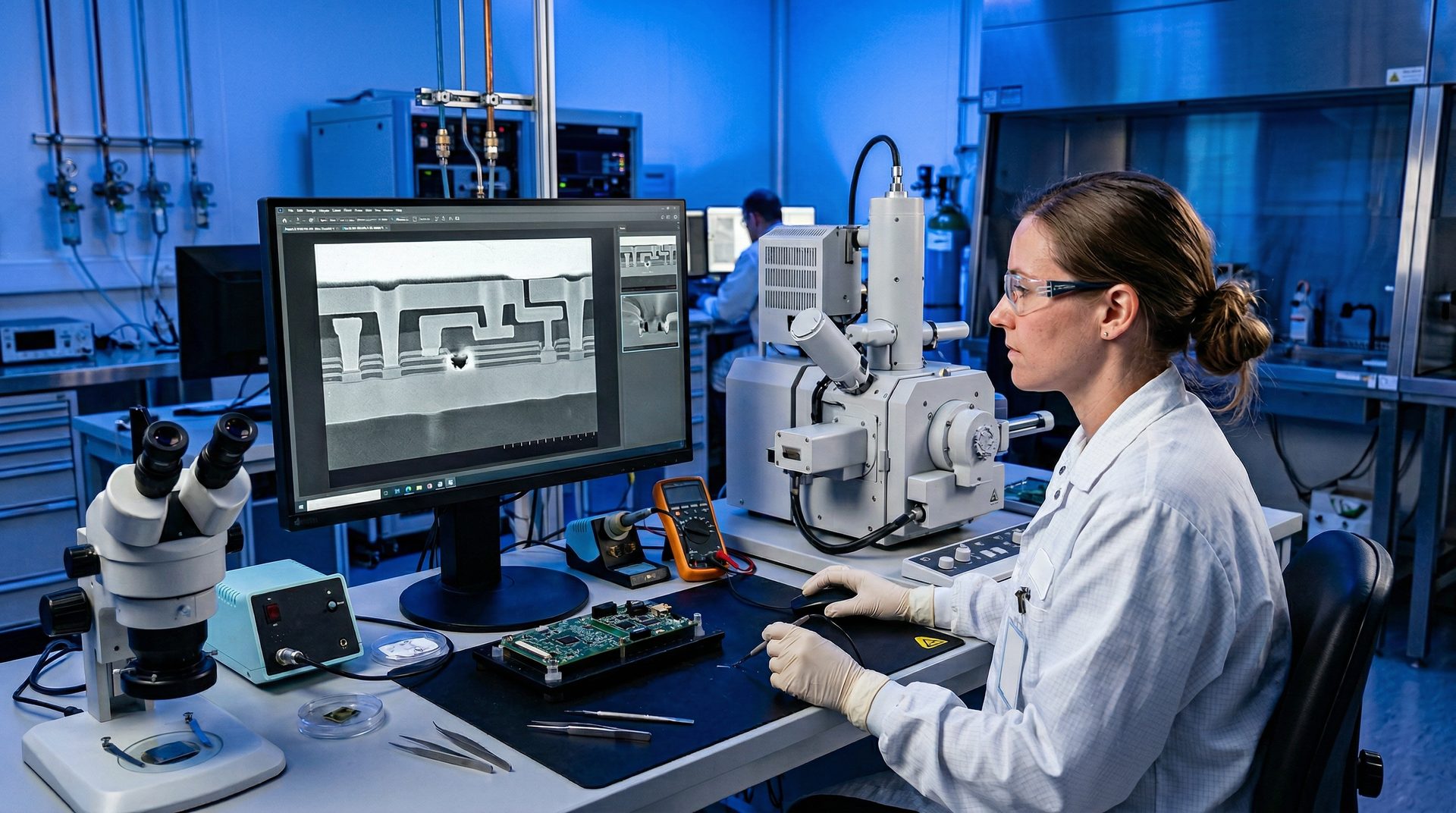
Focused ion beam (FIB) cross-sectioning provides access to the sub-surface structure of an IC with precision that no other technique matches. A FIB instrument uses a finely focused beam of gallium ions to mill through the device at specific locations selected from the SEM plan view, producing a cross-section with nanometer-scale spatial resolution. FIB cross-sections reveal the transistor gate oxides, interconnect metal layers, dielectric films, and contact structures that define the IC's design implementation. In patent litigation, FIB cross-sections at specific circuit locations can directly address claim construction disputes about whether a defendant's IC implements a patented structure. In failure analysis, FIB cross-sections at identified failure sites reveal the physical mechanism of failure with the specificity required for root cause attribution.
Transmission electron microscopy (TEM) extends the analytical resolution of FIB cross-sections to the atomic scale, enabling direct imaging of individual atomic columns in crystal structures, thin dielectric films only a few atomic layers thick, and interface structures that govern device reliability. TEM analysis combined with energy-dispersive X-ray spectroscopy (EDS) or electron energy loss spectroscopy (EELS) provides elemental composition maps at near-atomic resolution. For matters involving allegations of process defects, material substitution, or counterfeit die with different process technology than claimed, TEM-EDS analysis provides the definitive physical record of what was actually fabricated in the component under examination.
SEM Die Surface Examination
High-resolution scanning electron microscope imaging of exposed die surfaces documenting layout, circuit structures, ESD damage, metal migration, and visible failure sites.
FIB Cross-Sectioning
Precision site-specific cross-sections at nanometer resolution, revealing transistor structures, interconnect layers, and subsurface defects at litigation-critical locations identified by counsel.
TEM and Material Characterization
Atomic-resolution TEM imaging with EDS elemental mapping to document dielectric film thickness, interface composition, and process technology at the nanometer to sub-nanometer scale.
Electrical Fault Isolation
Photoemission microscopy (PEM) and emission microscopy (EMMI) techniques to localize electrical failure sites on the die before physical cross-sectioning, ensuring examination resources are directed to the correct location.
Counterfeit IC Detection for New York Supply Chain Disputes
The counterfeit semiconductor problem has grown substantially more complex as supply chain pressures have driven buyers to authorized and unauthorized distributors alike. New York, as a major logistics hub with extensive electronics distribution activity, is a frequent venue for disputes over counterfeit components. NYCF has performed counterfeit IC analysis for matters involving distribution companies based in the New York metropolitan area, defense contractors with NY offices managing government supply chain audits, and electronics manufacturers in Long Island's industrial corridor responding to customer complaints about component quality.
Counterfeit integrated circuits present in several distinct categories, each requiring a different analytical emphasis. Remarked or blacktopped parts are genuine ICs with their original markings removed and replaced with markings for a different, typically more valuable, part number or a higher-temperature or reliability grade. Detecting these requires comparison of internal die geometry against known authentic specimens for the claimed part: the transistor count, die dimensions, and circuit organization visible in SEM examination do not change when the package is remarked. Recycled or refurbished parts are authentic components that have been removed from used equipment, cleaned, and re-sold as new. Evidence of prior use appears in lead finish condition, surface oxidation patterns, solder residue on device leads, and mechanical wear marks on package corners that are inconsistent with unused components.
Cloned parts represent a more technically sophisticated counterfeiting approach: fabricating a die that approximates the target part's function without using the original manufacturer's process technology or mask set. Clone detection requires process technology comparison through TEM cross-section and material characterization. An authentic processor fabricated on a 7nm FinFET process has physically measurable structural characteristics that a counterfeit fabricated on an older planar process cannot replicate, regardless of functional similarity. NYCF's analytical capabilities address all three counterfeit categories with the same documentation rigor required for litigation support.
For matters involving Department of Defense procurement, NYCF's counterfeit detection analysis is aligned with the requirements of AS6081, the Aerospace Standard for Fraudulent/Counterfeit Electronic Parts that applies to aerospace and defense supply chains. While NYCF is not an AS6081-certified distributor, NYCF's analytical reports document the specific tests and criteria from AS6081 that each component satisfies or fails, providing a technically defensible basis for compliance-related litigation and contract disputes involving defense contractors with New York offices.
IC Forensics for SDNY Patent Litigation and NY Product Liability
The Southern District of New York handles a significant volume of patent infringement litigation involving electronic products and semiconductor devices. Midtown Manhattan's concentration of technology company offices, financial technology developers, and semiconductor IP licensing firms generates patent disputes that require technical analysis of the accused product's hardware implementation at the circuit level. NYCF serves as a technical expert resource for patent litigation counsel at New York firms handling these matters, providing both pre-litigation technical assessment and formal expert witness services through trial.
Patent infringement analysis for IC-implemented inventions requires mapping the physical structure of the accused chip to the claim language of the patent in suit. This is a technically demanding exercise because claim construction by the court may specify structural elements, functional requirements, or process characteristics that must be confirmed at the microscopic level. NYCF works with litigation counsel and claim construction experts to identify the specific physical features that the accused product must have to infringe each asserted claim, then designs an analytical program to document the presence or absence of those features in the physical evidence. The resulting report links specific FIB cross-section images or SEM micrographs to specific claim elements, providing a direct technical foundation for infringement contentions.
Product liability matters in New York state courts frequently involve electronic products where component failure caused property damage or personal injury. A medical device that ceased functioning due to electrostatic discharge damage in an IC, an industrial controller that caused a fire because a capacitor failed to specification, or a consumer product that injured a user because a power management IC was running beyond its rated thermal limits: in each case, the forensic question is the physical mechanism of the IC failure and whether that mechanism traces to design deficiency, manufacturing defect, process variation, or misuse. NYCF's failure analysis reports address these questions with the specificity that New York product liability law requires for proximate cause testimony.
Insurance claims for electronic equipment losses in New York frequently require IC-level forensic analysis to establish causation. New York's concentration of financial institutions, hospitals, and technology companies creates a substantial market for commercial property and equipment breakdown coverage, and disputes about whether an IC failure resulted from a covered peril or a maintenance failure often require technical forensic input. NYCF provides forensic analysis reports for insurance matters that document the physical cause of component failure, the timeline of the damage mechanism, and whether the failure mode is consistent with the claimed loss event. This analysis supports both the insurance company's claim evaluation process and, where coverage is disputed, the policyholder's position in coverage litigation before New York courts.